
For Research Use Only (RUO): This content is intended strictly for educational and laboratory research purposes. Products and materials referenced on this site are not intended for diagnostic, therapeutic, or human/animal use.
Understanding Peptide Molecular Weight in RUO Research
Understanding peptide molecular weight and amino acid sequences is essential for researchers working with RUO compounds. When evaluating research-grade peptides, two technical specifications appear on nearly every Certificate of Analysis: molecular weight and amino acid sequence. These values are not just catalog details — they define how a peptide behaves in experimental conditions, how it interacts with other molecules, and how researchers can reproduce results across studies.
This guide explains what molecular weight and amino acid sequences mean in the context of RUO peptide research, how to read these specifications, and why they matter for accurate, reproducible laboratory work.
For a broader foundation on research peptides, see: Research Peptides Explained: The Complete Guide for Modern Laboratory Research
What Is Peptide Molecular Weight in Research?
Molecular weight (MW) refers to the total mass of a peptide molecule, and researchers express it in Daltons (Da) or kiloDaltons (kDa). It is calculated by summing the atomic masses of every atom in the peptide’s chemical structure.
In RUO research settings, molecular weight is important for several reasons:
- It allows researchers to calculate molar concentrations accurately for use in quantitative assays
- It serves as a verification tool — the MW reported on a CoA should match the theoretical MW of the peptide’s amino acid sequence
- It is used during mass spectrometry (MS) analysis to confirm peptide identity and detect synthesis impurities
A discrepancy between theoretical and observed molecular weight on a mass spec readout is a key indicator of synthesis error, degradation, or contamination. Reviewing this data on a CoA before use is considered best practice in any rigorous RUO lab workflow.
For more on how MS is used to verify peptide quality, see: How Peptide Purity Is Measured: Understanding HPLC, MS, and RUO Quality Specifications
What Is an Amino Acid Sequence?
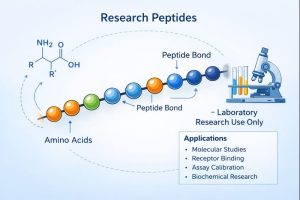
A peptide is a chain of amino acids bonded together by peptide bonds. The amino acid sequence — often written as a string of single-letter or three-letter codes — defines the exact order of those amino acids from the N-terminus to the C-terminus of the chain.
The sequence is the structural identity of a peptide. Two peptides with the same amino acid composition but different sequences will have entirely different properties and behaviors in research settings. This is why sequence verification is a non-negotiable step in RUO quality documentation.
How Sequences Are Written in Research Documentation
Amino acid sequences are typically expressed using standard IUPAC single-letter codes. For example, the tripeptide GHK (Glycine-Histidine-Lysine) is written as G-H-K. Longer peptides such as BPC-157, which contains 15 amino acids, are written as a full sequence string: GEPPPGKPADDAGLV.
Researchers use sequence data to cross-reference peptides against published literature and database entries such as those found in PubChem or UniProt, ensuring the material being studied matches the compound described in reference studies.
Why Sequence Accuracy Matters for Reproducible RUO Research
Sequence accuracy is directly tied to experimental reproducibility. If a peptide is synthesized with even one incorrect or missing amino acid, its structural conformation, charge distribution, and binding characteristics may differ significantly from the intended compound.
In receptor-binding studies, pathway modeling, and analytical assay work — all common applications for RUO peptides — sequence fidelity determines whether data generated is meaningful and comparable to existing published findings.
This is why researchers sourcing RUO peptides should always confirm that suppliers provide full sequence documentation alongside analytical testing data. For guidance on evaluating that documentation, see: How to Read a Peptide CoA — Step-by-Step Guide for RUO Peptides
Molecular Weight Ranges Across Common RUO Research Peptides
Furthermore, research peptides vary widely in molecular weight depending on their length and composition. Understanding where a peptide falls on the MW spectrum can inform assay design and analytical method selection.
Small Peptides (Under 500 Da)
For example, typically 2 to 4 amino acids in length. Examples include dipeptides and tripeptides used in binding interaction studies. GHK (Glycine-Histidine-Lysine), available as GHK-Cu 100 mg from PeptideVerse, has a molecular weight of approximately 340 Da.
Mid-Range Peptides (500 Da – 2,000 Da)
Peptides in this range are among the most widely used in RUO research. They are large enough to exhibit meaningful receptor interactions but small enough for reliable MS verification. BPC-157 10 mg, a 15-amino acid peptide with a MW of approximately 1,419 Da, falls within this category.
Larger Research Peptides (2,000 Da and Above)
Longer peptide chains and peptide blends tend to fall in this range. Compounds like Tesamorelin 5 mg, a 44-amino acid peptide analog used in laboratory research contexts, have significantly higher molecular weights and require more rigorous analytical documentation to confirm identity.
The Relationship Between Sequence, Molecular Weight, and Purity
Molecular weight, sequence, and purity are interconnected data points that together paint a complete picture of a peptide’s quality. A high-purity peptide with a confirmed sequence and verified MW provides the highest confidence in experimental outcomes.
Researchers should treat these three data points as a package — not independent values. A peptide with 99% HPLC purity but an unverified sequence still introduces uncertainty into mechanistic studies. Conversely, a confirmed sequence with low purity introduces background interference that can skew binding and signaling data.
For a detailed breakdown of purity grades and what they mean in practice, see: Peptide Purity Grades Explained: What 95%, 98%, and 99%+ Mean for RUO Research
Reading MW and Sequence Data on a Certificate of Analysis
A properly formatted RUO peptide CoA should include the following fields related to molecular weight and sequence:
- Molecular Formula — the elemental composition of the compound (e.g., C₆₂H₉₈N₁₆O₂₂)
- Theoretical Molecular Weight — the calculated MW based on the sequence
- Observed MW (MS result) — the MW detected by mass spectrometry during QC testing; should match theoretical within instrument tolerance
- Amino Acid Sequence — the full sequence string, written N-terminus to C-terminus
- Sequence Confirmation Method — typically listed as MS or MS/MS
If any of these fields are absent from a supplier’s CoA, researchers should request the missing documentation before proceeding with experimental use of the material. View PeptideVerse CoA documentation here: SDS/COAs
External Scientific References
- PubChem – Peptide Molecular Data and Chemical Structures
- NCBI PubMed Central – Amino Acid and Peptide Research Literature
- UniProt – Protein and Peptide Sequence Database
Conclusion
Molecular weight and amino acid sequence are two of the most critical technical specifications in RUO peptide research. Together, they define a peptide’s chemical identity, guide experimental design, and provide the foundation for reproducible, verifiable laboratory results.
Accordingly, researchers working with RUO peptides should always verify both values against supplied CoA documentation before incorporating any material into a study workflow. Suppliers that provide complete, transparent analytical documentation — including sequence confirmation and MS-verified molecular weight — support more rigorous and defensible research outcomes.
RUO Reminder: All peptides available at PeptideVerse are sold strictly for Research Use Only. They are not intended for human or animal administration, diagnostic use, or therapeutic application. Use of these materials must comply with all applicable local, state, and federal regulations governing research-grade chemical reagents.