
For Research Use Only (RUO): This content is intended strictly for educational and laboratory research purposes. Products referenced on this site are not for diagnostic, therapeutic, or human/animal use.
Introduction to Top Research Peptides RUO: Laboratory Applications Overview
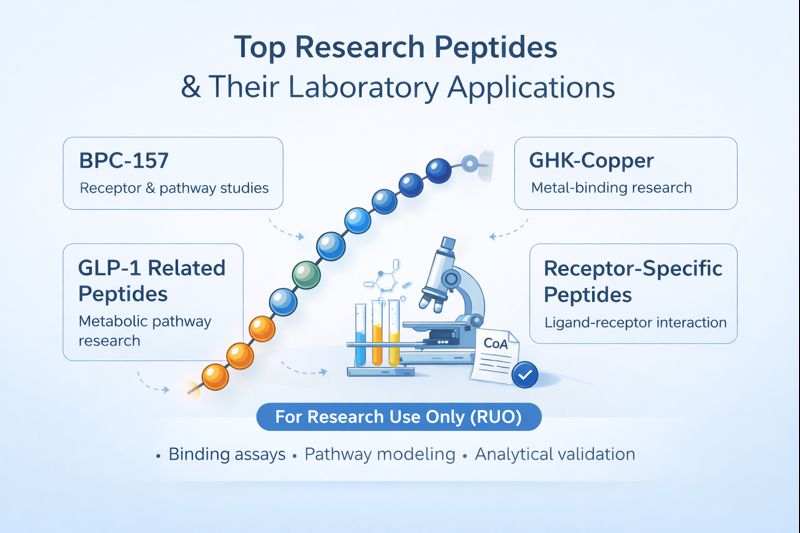
The growing body of peer-reviewed research on synthetic peptides has established several compounds as among the most extensively studied top research peptides RUO materials in laboratory science. These applications span receptor binding studies, biochemical pathway modeling, metal-chelation research, and analytical assay development — all conducted in controlled, non-clinical research environments.
Specifically, this guide profiles the most studied RUO research peptides, explains their primary laboratory applications, and outlines the quality standards that make them suitable for reproducible scientific investigation.
BPC-157 — Body Protection Compound in RUO Research
For example, BPC-157 (Body Protection Compound-157) is a 15-amino acid synthetic peptide derived from a protein found in gastric juice. Its sequence — GEPPPGKPADDAGLV — is one of the most frequently cited in the RUO peptide literature. Laboratory researchers use BPC-157 extensively for:
- Angiogenesis and vascular biology studies
- Tissue repair mechanism investigation in cell culture models
- Nitric oxide pathway research in non-clinical settings
- Receptor interaction studies with growth factor receptors
As one of the top research peptides laboratory applications in the RUO space, BPC-157 is available at PeptideVerse as BPC-157 10 mg, supplied with HPLC and MS documentation confirming sequence and purity.
GHK-Cu — Copper Peptide in Biochemical Research
Additionally, GHK-Cu (Glycine-Histidine-Lysine-Copper) is a naturally occurring tripeptide with copper-binding properties. It is among the most widely studied small peptides for metal-binding interaction research. Laboratory applications include:
- Metal-binding and copper transport mechanism studies
- Extracellular matrix modeling in cell-free systems
- Wound healing pathway analysis in non-clinical research models
- Superoxide dismutase activity studies related to antioxidant biochemistry
GHK-Cu is available at PeptideVerse as GHK-Cu 100 mg, one of the highest-volume research peptides in our catalog.
GLP-1 Related Peptides — Receptor and Metabolic Research
Furthermore, GLP-1 (Glucagon-Like Peptide-1) related compounds are extensively used in laboratory research focused on G-protein coupled receptor (GPCR) biology and metabolic signaling pathways. These research applications are conducted exclusively in non-clinical laboratory environments.
Common laboratory uses include:
- Receptor activation and signaling cascade studies
- cAMP pathway modeling in cell-free or cell-culture assays
- Comparative binding affinity studies between GLP-1 analogs
- Assay development for receptor ligand characterization
PeptideVerse offers RUO GLP-1 related research materials including GLP-3 RT and GLP-2 TZ for qualified laboratory use.
NAD — Nicotinamide Adenine Dinucleotide Research
Moreover, NAD (Nicotinamide Adenine Dinucleotide) occupies a central role in cellular metabolism research. It functions as a coenzyme in over 400 enzymatic reactions and is extensively studied in the context of mitochondrial function, sirtuin activity, and cellular energy metabolism.
Laboratory research applications include:
- Sirtuin (SIRT1-7) activity assays and NAD-dependent deacetylase studies
- Mitochondrial respiration modeling in cell-based RUO systems
- PARP (Poly ADP-ribose polymerase) activity research
- Aging biology and cellular senescence pathway studies
Available at PeptideVerse as NAD 500 mg for RUO laboratory research.
MOTS-C — Mitochondrial Peptide Research
In addition, MOTS-C is a 16-amino acid mitochondria-derived peptide encoded in the mitochondrial genome. It has emerged as a significant compound of interest in metabolic biology research. Top research peptides laboratory applications for MOTS-C include:
- AMPK pathway activation studies in cell culture systems
- Insulin sensitivity and glucose metabolism research models
- Mitochondrial signaling and retrograde communication studies
- Exercise physiology pathway modeling in non-clinical settings
Selank and Semax — Neuropeptide Analog Research
Similarly, Selank and Semax are synthetic neuropeptide analogs that are actively studied in laboratory neuroscience research. Their applications in top research peptides laboratory applications settings include:
- BDNF (Brain-Derived Neurotrophic Factor) pathway studies
- Anxiolytic mechanism research in non-clinical assay systems
- GABAergic and serotonergic receptor interaction studies
- Neuroplasticity marker analysis in cell culture models
Both are available at PeptideVerse for qualified RUO laboratory research: Selank 10 mg and Semax 10 mg.
How Researchers Select RUO Peptides for Studies
Therefore, selecting among top research peptides laboratory applications requires evaluating several factors beyond the peptide’s scientific literature profile.
Purity Documentation
Any RUO peptide considered for use in a study should be backed by HPLC purity data and mass spectrometry identity confirmation. Without these documents, the compound’s fitness for research cannot be verified. See: How to Read a Peptide CoA
Sequence Verification
The amino acid sequence on the CoA should be verified against published references or database entries (PubChem, UniProt) before experimental use. See: Understanding Peptide Molecular Weight and Amino Acid Sequences in RUO Research
Purity Grade Selection
Match the purity grade to the sensitivity of your assay. Receptor binding studies generally require ≥98% purity. See: Peptide Purity Grades Explained
External Scientific References
- PubChem – Peptide Chemical Data
- NCBI PubMed Central – Peptide Research Literature
- UniProt – Protein Sequence Database
Conclusion: Working with Top Research Peptides RUO Compounds
The top research peptides laboratory applications documented in this guide represent some of the most studied compounds in modern biochemical and molecular research. BPC-157, GHK-Cu, GLP-1 analogs, NAD, MOTS-C, Selank, and Semax each have established laboratory use cases supported by a growing body of published research.
Selecting the right compound for your study requires matching the peptide’s documented research profile to your experimental design, verifying documentation, and ensuring all materials are used strictly within RUO compliance boundaries.
RUO Reminder: All peptides available at PeptideVerse are sold strictly for Research Use Only. They are not intended for human or animal administration, diagnostic use, or therapeutic application.