


Peptide Research 101: Everything a New Lab Technician Should Know
Starting out in peptide research can feel overwhelming—but it doesn’t have to be. This primer covers the essentials a new technician needs for
Research-Use-Only (RUO) peptides: what peptides are, how to handle and store them,
and how to verify quality with HPLC and
mass spectrometry (MS).
Master these fundamentals to protect data integrity and build lab confidence.
What you’ll learn:
- Peptide basics: definitions, types, and laboratory applications
- Best practices for reconstitution, solubility, and storage
- How to read a Certificate of Analysis (COA) and confirm identity
- Safety, documentation, and SOPs for RUO environments
What Are Peptides? A Quick Scientific Overview
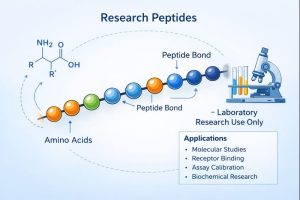
Peptides are short chains of amino acids linked by peptide bonds—typically 2–50 residues—while longer chains are considered proteins.
Despite their size, peptides drive critical biological processes, including cell signaling, metabolism, and immune response.
For an academic overview, see the Nature Peptide Chemistry hub.
Peptides vs. Proteins: The Key Differences
| Feature | Peptides | Proteins |
|---|---|---|
| Length | 2–50 amino acids | 50+ amino acids |
| Structure | Often simple/linear | Complex, folded domains |
| Typical Use | Binding, signaling, assays | Enzymatic, structural, regulatory |
| Handling | Solubility/pH sensitive | Folding/stability sensitive |
Common Types of Research Peptides
- Synthetic peptides: custom sequences for interaction studies and assays
- Bioactive peptides: derived from natural sources for physiology research
- Cyclic peptides: enhanced stability; used in screening and receptor work
- Labeled peptides: fluorescent or isotopic tags for detection and quantitation
The Role of Peptides in Laboratory Research
Biochemistry & Cell Biology Applications
Peptides serve as simplified, controllable models to probe enzyme mechanisms, epitope recognition, and signaling pathways.
They’re invaluable in receptor-ligand studies, biomarker discovery, and assay development.
Peptide Libraries & High-Throughput Screening
Combinatorial libraries enable rapid screening of thousands of sequences to identify active motifs or optimize binding affinity and selectivity.
Essential Peptide Handling and Storage Techniques
Understanding COAs and RUO Labeling
Each peptide should arrive with a COA stating sequence,
purity (commonly via HPLC), and identity (commonly via MS). RUO labeling means materials are intended strictly for laboratory research,
not diagnostic or therapeutic use. File COAs with batch logs for traceability.
Reconstitution & Solubility Best Practices
- Use COA-recommended solvent; begin with minimal volume to fully dissolve, then dilute.
- Favor gentle swirling; avoid aggressive vortexing or prolonged sonication that can heat or shear.
- Adjust pH carefully if needed; record final pH and solvent composition in your lab log.
- If sterility is required, filter with low-protein-binding membranes after complete dissolution.
Storage: Temperature, Moisture, & Light Control
- Lyophilized: store at −20 °C (or colder per COA) in sealed, desiccated vials; use amber containers for light-sensitive peptides.
- Reconstituted: store at 4 °C for short-term (2–4 weeks typical); aliquot and freeze for longer-term storage to avoid repeated thawing.
- Minimize oxygen exposure; consider inert gas headspace (N2/Ar) for oxidation-prone sequences.
Quality Control and Analytical Testing
High-Performance Liquid Chromatography (HPLC)
HPLC separates components to provide a purity profile (main peak vs. side products). For a fundamentals refresher, see
ChemGuide: HPLC Basics.
Mass Spectrometry (MS) & Identity Verification
MS confirms molecular weight and supports sequence verification; together with HPLC, it ensures the vial matches the intended product.
Learn core principles at NIST: Mass Spectrometry.
Safety, Documentation, and Compliance
Handling RUO Materials Responsibly
Always use PPE (gloves, eye protection, lab coat) and follow your chemical hygiene plan. RUO peptides are not for human or animal use.
Recordkeeping: Batch, Concentration, Storage
- Log batch numbers, concentration, solvent/buffer, pH, preparer, and dates.
- Maintain a freezer map and inventory to track vial locations and expiry timelines.
Follow SOPs for Consistency
SOPs reduce variability, prevent contamination, and protect reproducibility. Standardize reconstitution, aliquoting, labeling, and QC checkpoints.
Common Mistakes New Technicians Should Avoid
Cross-Contamination During Pipetting
Use fresh tips per transfer; stage one peptide at a time; clean work surfaces with 70% IPA.
Over-Agitation or Improper Solvent Choice
Gentle mixing prevents aggregation; follow COA solvent/pH recommendations precisely.
Labeling & Documentation Errors
Adopt clear naming and consistent labels; include date, initials, concentration, solvent, and batch.
FAQs: Common Questions About Peptide Research
1) What purity level is best for peptide research?
≥95% for most RUO work; consider ≥98–99%+ for sensitive assays.
2) How long can peptides be stored?
Lyophilized: years at −20 °C or below; reconstituted: 2–4 weeks at 4 °C (see COA).
3) Can peptides be reused after thawing?
Avoid refreezing; aliquot to single-use vials immediately after reconstitution.
4) How can I test identity?
Use HPLC for purity and MS for molecular mass/identity confirmation.
5) Are RUO peptides dangerous?
Handle with standard PPE; follow institutional safety procedures. Not for diagnostic or therapeutic use.
6) Can I mix multiple peptides in one solution?
Only when specified by protocol and sequences are compatible; otherwise keep separate.
Conclusion: Build Confidence with Sound Fundamentals
Peptide research success hinges on disciplined handling, storage, verification, and documentation.
As you develop your skills, rely on COAs, consistent SOPs, and analytical checks to ensure reliable results.
Explore more resources on the PeptideVerse Blog,
learn how to read COAs here,
and browse high-purity RUO peptides in our catalog.
External resources:
Nature – Peptide Chemistry •
ChemGuide – HPLC Basics •
NIST – Mass Spectrometry