For Research Use Only (RUO): This content is intended strictly for educational and laboratory research purposes. Products and materials referenced are not approved for human or veterinary use and are not intended for diagnosis, treatment, cure, or prevention of any disease.
Introduction
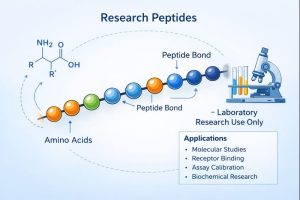
Research peptides are essential tools in biochemical, molecular, and analytical studies. Their defined amino acid sequences allow researchers to study biological mechanisms under controlled laboratory conditions. This article explores commonly studied research peptides, their laboratory applications, and how researchers select them while maintaining strict RUO compliance.
If you are new to the topic, we recommend starting with our foundational guide:
Research Peptides Explained.
What Defines a Research Peptide?
Research peptides are synthetically produced amino acid chains used in laboratory experiments such as receptor binding studies, assay validation, and molecular interaction modeling. These compounds are manufactured for research use only and are not classified as therapeutic agents.
To better understand how peptide quality impacts experimental outcomes, see:
Peptide Purity Grades Explained.
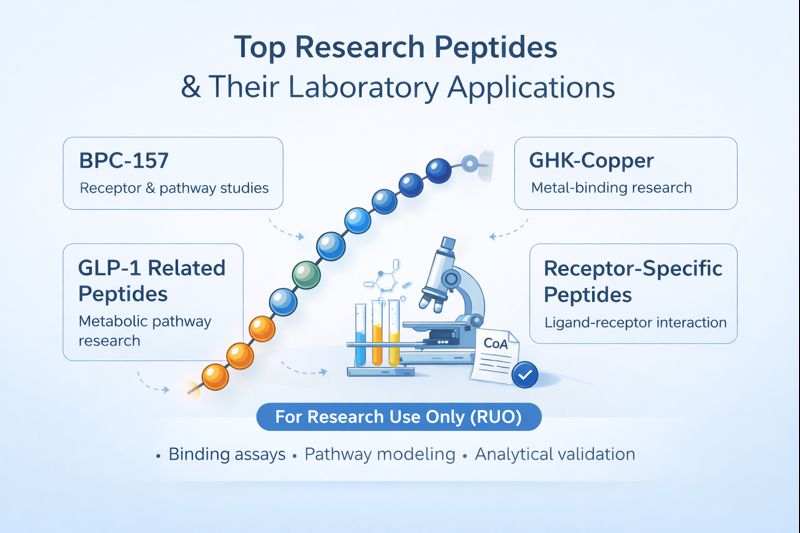
Commonly Studied Research Peptides & Their Applications
BPC-157
BPC-157 is frequently studied in laboratory environments for its role in cellular signaling and structural interaction research. Its stability and defined sequence make it useful in controlled receptor and pathway modeling experiments.
GHK-Copper
GHK-Copper is a tripeptide used in biochemical studies involving metal-binding interactions. Researchers often evaluate its affinity characteristics when studying molecular transport and protein binding dynamics.
GLP-1 Related Peptides
GLP-1 related peptides are commonly used in laboratory research to study receptor activation and metabolic signaling pathways. These studies are conducted exclusively in non-clinical research settings.
Example RUO material:
GLP-3 RT (Research Use Only).
Receptor-Specific Peptides
Some research peptides are engineered for high receptor specificity. These compounds allow researchers to isolate ligand-receptor interactions without introducing full protein structures.
How Researchers Select Research Peptides
Selecting appropriate research peptides involves evaluating purity, documentation, and reproducibility. High-quality peptides reduce variability and improve confidence in experimental data.
For guidance on avoiding common laboratory errors, review:
Common Lab Mistakes That Affect Peptide Purity.
Key Selection Criteria
- Verified purity via HPLC and mass spectrometry
- Clear Certificates of Analysis (CoA)
- Consistent batch-to-batch results
Laboratory Applications of Research Peptides
Research peptides are widely used across academic and private research laboratories. Their applications include analytical testing, assay development, and molecular interaction studies.
- Binding Assays: Measuring peptide-protein affinity
- Receptor Mapping: Studying ligand specificity
- Pathway Modeling: Evaluatin